Saturday, August 15, 2009

The Garden in Review


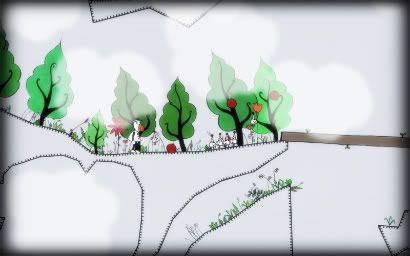
From the get-go, everything aligned to get the hype kicking around IGF victor Blueberry Garden: the early, enigmatic trailer, Erik Svedäng's crazy hairdo, the unveiling of a launch date on Steam, and of course the agonizing last-minute delays. Some people responded to this sequence of events with heightened expectations, ready to lash out ; others, like Destructoid's Anthony Burch (he of the excellent but hard-to-browse Indie Nation column), took it as a genuine "happening" of indie gaming, and seized the opportunity to fully engage with the piece, albeit not as critically as might have been the case with a lesser title. It was an odd, confusing encounter, but one that ended up yielding a peculiar sense of reward for the right people. Not since the release of Tale of Tales' The Path back in March had the community seemed so divided.

Declaring my time with Blueberry Garden some of the most pleasurable I ever spent in front of a personal computer would come off a little naive, so let's just say it delivered one of the best gaming experiences I had this year. It was very interesting for me, then, to witness the game's public bashing on GameSpot, courtesy of Kevin VanOrd's review (assorted with a rather aggravating score of 5.0). Interesting because, as defensive as I was of the game, I found myself mostly agreeing with the writer's main points, especially regarding technical issues. I would even go so far as insisting on the game's very spotty collision detection, which can lead to some awkward situations. What I didn't share, however, was VanOrd's apparent bafflement at what he refers to as a general "shallowness".

Contrast this with Burch's early appreciation of the game, obviously written in a spur of sudden admiration. Quickly, the writer notes the "focus" of the game's design and layout, as well as the solidity of the exploration mechanics that "make the blueberry garden an enjoyable place to explore on a purely mechanical level". Soon, it becomes clear that Burch took great pleasure in the piece's "big reveal", which completely changed his approach to the game on subsequent tries. And this, I believe, is the defining morsel of these impressions: whereas the aforementioned review criticized the game as a whole package, after the fact, Mr. Burch writes of his interest in the process of discovery, of his personal feelings while piecing the game's admittedly modest "enigma", but also of his encounter with the game's world and dynamics. Is this an aspect that Mr. VanOrd failed to appreciate? Is this factor even relevant at all?

Intrigued, I took this conflict of opinion with a site I have always held in high respect as an opportunity to risk a look at Gamespot's reviewing policy. What I found there was quite illuminating, not so much concerning Blueberry Garden's harsh treatment, but about the outfit's approach to criticism as a whole. Apart from the expected statements regarding the all-important money and time of the player (surprisingly, the term "value" is not insisted on), one criteria that stood out from the rest was that of the "rising standards" of game reception. Bluntly put, this means that "each time an excellent game is released, it becomes incrementally more difficult for another game to be as good in the grand scheme of things." While pretty consistent with my knowledge of Gamespot's activities over the years, I couldn't help but be slightly shocked by these words ; I suddenly pictured a gaming press that will never, ever be satisfied, and whose sole nods of approval will only ever mean: "Good job... for now". And while a severely critical attitude will never do any "harm" in a strict sense, it will remain the prime rival of one of art's most important abilities: to delight and fascinate.

Gamespot claims to cater to the "discriminating player", which seems reasonable enough, albeit still a little vague. And yet, as "discriminating" as I consider myself to be, I couldn't help but be absolutely taken by the Blueberry Garden's pacing and presentation, and spent an inordinate amount of time toying around with the widely-claimed but seemingly underappreciated "ecosystem" thought up by Svedäng. Fraser McMillan of Resolution Magazine also wrote of this peculiar pleasure, comparing the game to Takahashi's Noby Noby Boy ; despite the game's rather limited expanse, there simply isn't anything quite like attempting to keep the garden lively and well-spread, totally disregarding the completion of the game. And it is precisely this kind of personal enjoyment, this kind of autonomous goal-setting, that formal reviews of any game will fail to acknowledge. Especially in a medium where "meaning" isn't as esteemed a factor as in film or poetry, reviews are bound to hit a wall ; there is only so much words that one can apply to the technicalities of what essentially amounts to a toolset, and from then on it's up to the player to make up his own mind. Such are the limits of traditional game criticism, and the reasons why we need more personalized, oriented writing on the subject.

As a surprise ending to this story, I was thrilled to find that Gamespot had finally gone ahead and published a highly-favorable review of The Path just a few days ago (complete with 8.0 rating) ; a game that is sure to cause a great divide among the readers who choose to follow the reviewer's advice. Especially worth noting is that the man behind this risky text is none other than Kevin VanOrd, who goes on to examine the game's unusual merits in clear, literate language. To me, this makes one thing clear above all else: that Mr. VanOrd is an opinionated, open-minded critic capable of nuance and bold partiality. After all, one doesn't go championing Assassin's Creed and Metal Gear Solid 4 on the same terms as Flower and Everyday Shooter without some sense of purpose (or at least of passion), and I believe such virtues are valuable to the growth of the art form as a whole. At the same time, this just goes to show that one's opinion remains just that, and that a critical mind will take it to heart to scan various sources before making a stand of its own.

Sunday, August 9, 2009

Playing Catch-up

From what I have posted thus far, you may have gathered that I have spent a fair bit of the summer "catching up" with some of the most acclaimed and/or discussed video games of the last few years. It's a funny thing, arriving at the party late and having a go at the left-overs ; a bit like waiting for a movie to come out on DVD, once everything has already been said. At the same time, playing from such a Critical Distance can prove a wonderful occasion to sift once again through the discourse surrounding the games and to tackle the origins of some current trends in game design hands-on ; in short, to experience the works in a way that was perhaps not intended, but that can still shed light on certain overlooked aspects.

Concentrating on those big, "important" games, however, has led me to neglect the freeware brewings of the independents for some time, which upset me a tiny bit. Part of the reason for this was that the last "big" indie, IGF winner Blueberry Garden (on which I will have more to say), had satisfied me so completely. Another part of it was that, although I seemed able to keep track of which efforts were garnering buzz at the moment, I simply couldn't get into the wholly different mindset that these little games require from the player. Still, the best part about following indie gaming is that a few months or even weeks of absence is likely to spin as many single interesting titles as a few years in the mainstream market ; games of much smaller scope, obviously, but definitely not lacking as far as design or creative chops are concerned.

Here are the links to a few games I have caught up with in the last couple of weeks, each followed by the reason that I think you should play them for.

Alabaster - Led by interactive fiction guru Emily Short, this fascinating take on a familiar tale features acute and suspenseful writing, impeccably managed by a smooth interface. Multiple plays recommended.

Aubergine Sky - Confident and carefully written, this promising "true story" from Jonathan Whiting follows in the wake of Daniel Benmergui, attaining intimacy through simple design and elegant mechanics.

The Beggar - Dropping from out of nowhere, this microscopic webgame slightly reminiscent of Passage turns out to be one of the most eloquent and smartly-conceived "gamey" works of the year. All the best for developer Scott Brodie.

Heed - As close to theater as a video game could get without selling its soul, this short AGS effort touches on themes of esoteric spirituality through appropriately austere puzzles and art design. Hypnotic work from Ben Chandler.

MoneySeize - Probably the less "arty" title of this bunch, Matt Thorson's latest is one of the most inspired exercises in pure, infuriating platforming since... Matt Thorson's own FLail. Excellent layouts and sense of flow throughout.

Rosemary - This short student project from MIT, as flawed as it is gorgeous, almost fulfills the potential of a truly novel mechanic in gaming. Polished and expanded upon, one could see the concept taking on tremendous dimensions.

Tanaka's Friendly Adventure - Too small for a Game Boy cartridge, more expansive than a virtual pet, this portable-style "game" turns mindless navigation, compulsive collecting and instant characterization into a strangely compelling experience. Would be sickening if it didn't look so sincere in the first place.

Upgrade Complete - Time will tell if the so-called "meta" games, turning the conventions of gaming into one big joke (see Jesse Venbrux's mind-bending Karoshi 2.0), manage to make the slightest dent in our habits. In any case, Armor Games' second take on the trend (following the lighter Achievement Unlocked), takes no prisoners, deconstructing the dynamics of cheap reward-driven gameplay with pin-point accuracy.

Use Boxmen - Every once in a while, a charming puzzler turns up and toys around a fresh concept with such style and effortless grace that you wonder why it hasn't been done before. Greg Sergeant's latest is one such aimless endeavor, and pays you back with merry humor and irresistible music.

When Pigs Fly - Last but not least, this expertly-crafted lesson in physics and level design from Anna Anthropy/Dessgeega/Auntie Pixelante is bound to keep you glued to your keyboard, pondering the meaning of life for minutes on end (or not).

Many other indie games of 2009, especially from the first third of the year, would be absolutely deserving of any gaming enthusiast's attention. And even though my personal favorite and top priority for a write-up would be the unbearably fine Glum Buster, I hope to start featuring the sparkling "class of 2009" on a regular basis.

Wednesday, August 5, 2009

Now "Open for Traffic"

Today is the day that I start publicly sharing links to this blog, and I must confess to being a little nervous. I have worked hard over the last week to polish these first thousands of words and make them into a good read, and I hope that you enjoy what you find. I will now take a few days to collect my thoughts, and I hope to continue posting regularly, although perhaps not as often (or in shorter form). Feel free to let me know what you think!

Sunday, July 26, 2009

Sailing the Aesthetic Seas

Photobucket

I have played The Secret of Monkey Island up to the middle point since its recent release on digital services, and have been enjoying it about as much as expected. As a newcomer to the series, I was not only interested in the puzzles and humor, but also in the quirks of design and writing that would probably never find their way in today's commercial productions (but that the re-issue tactfully doesn't attempt to resolve). And as I suppose was the case for many other gamers, I have also treated myself to the delightful first episode of Tales of Monkey Island, whose synchronized release was a move of genius on the part of Telltale and Lucasarts. This particular game contained hints of decidedly modern design sensibilities, but also played without a doubt to some old-school conventions that I felt worked to its advantage. Curiously enough, these two gaming experiences did not inspire thoughts on the evolution of graphic adventure games proper, but more specifically on their use of sound and visuals. Let me elaborate some more.

One of the biggest selling points for The Secret of Monkey Island: Special Edition, of course, was its complete aesthetic make-over ; one that would propose a fresh look for the classic game, but retain its special brand of quirky charm. I don't know how it is for returning players (especially those who experienced the game with a functional brain back in 1990), but I find the greatest pleasure in systematically comparing the screens and trying to understand the stakes of the adaptation. What I didn't expect, however, was how clearly I would come to gravitate towards the old packaging, occasionally resorting to the new one for sensory enjoyment but not so much for gameplay purposes. I think there are several reasons for this, but suffice to say for now that I think the original version of Lucasarts' game was perfectly fine as it was, and that it may have actually lost some essential bits in the translation.

Tales of Monkey Island, for its part, confidently casts the graphic adventure series in the intimidating world of modern 3-D, just as Telltale previously did with its delightful Sam & Max episodes. But as great as this bound seems (computer graphics having come a long way since 2000's polygonal Escape from Monkey Island), what is especially pleasing about this rebirth is how understated it really comes off as: clean, unadorned textures, sparse environments and simple special effects constitute a visual design of minimal clutter and maximal efficiency. While budget concerns and limited technology were no doubt a factor in this output, there is a restrained mastery at work in the details and general tone ; an expertise that also transfers to the sound design, and more specifically to the voice work. In this regard, one need look (or hear) no further than the amusing prologue to witness the nuance and liveliness in Dominic Armato's performance of Guybrush Threepwood, accompanied by formidably expressive character animations. Some facial mannerisms may be overused, and Flotsam Island's denizens may look a little too alike, but there is a definite current of cohesion emanating from the game's overall presentation.

Photobucket

How ironic is it, then, to realize that this first episode of the series (subtitled Launch of the Screaming Narwhal) possibly didn't even need polygonal graphics and sophisticated sounds to function on the most basic level. Its camera angles are preset and passive, while its puzzles do not require advanced tridimensional navigation ; its few audio-based trials, apart maybe from a clever treasure hunt, could have been reduced to a few select cues, while its dialogue could have been just as easily read as text. It may be a slippery slope to step on, and this theory might shatter under the slightest bit of scrutiny, but let's throw this out anyway: in purely mechanical terms, I have no reason to believe that this modern-day Monkey Island wouldn't have sustained to be made using the founding SCUMM engine. Heck, it could probably function as a text adventure game and still retain much of its comic and ludic qualities. But that would turn it into a pretty different game now, wouldn't it...

The fact of the matter is this: all manners of graphic adventure games, from the early Sierra classics (also re-issued lately), to the 3-D iterations like Grim Fandango or Syberia, to the more recent gems authored in the Adventure Game Studio engine, rely on the same basic principles of cinematic language. Panning of the camera (be it horizontal scrolling or actual rotation of the virtual viewpoint), cuts from one space to another, shot-countershot exchanges for dialogues, high- and low-angle shots, scaling of depth ; all these figures have been employed to varying degrees of prominence over the history of adventure games, and mostly for the same purposes. On the one hand, in the same way that cinema and other representational mediums, the best uses of these features have enabled developers to yield images of evocative form, lifelike portrayals, and other manners of optic stimulation. Moreso than film, however, the basic requirement of the picture in adventure games is to efficiently transmit useful information to the "viewer" ; a role that the film image clearly shares, but not to the point of interrupting the story's progression in the case of fallacy. Both of these functions depend mostly on the inventive and capable use of computer graphics software, regardless of which techno-asset is presently deemed to be "state of the art".

Production values, then, mainly serve the purpose of crafting a compelling aesthetic experience for the user, which is probably not as negligible a component as I make it sound. While it will occur that a game's engine influence the core design of its puzzles, the usual goal will be to add style and form to what initially amounts to a cold mechanical construction. The only condition to this creative effort is that the art do not get in the way of the gameplay's unfolding ; in this regard, one need only look to the hugely-buzzed Time Gentlemen, Please! for an excellent example of a project's flow and tone being unobstructed and even complimented by "limited" resources and abilities (to say the least). As for any works of art, graphic adventure games demand to be judged on their own terms rather than according to the standards of the present day, which is exactly why the original Secret of Monkey Island can still be considered a great success of visual implementation: reduced to the top half of the screen, the playfield allows for denser images and less chances of missing information, while the bottom portion, unquestionably showing its age today, still proves to facilitate interaction with immediate feedback and effortless browsing. From this simple but solid foundation, it's really all about peppering the game world with fanciful touches that make it come alive, or signify, or otherwise amuse and dazzle.

Photobucket

Which brings me to the very serious problems I have with the Secret's 2009 make-over. On the surface, certainly, this reinvention would seem to have it all: its painterly vistas are lush and sprawling, while its atmospheric soundscapes inject the various maritime locales with a much greater sense of place than before. On a larger scale, it can also be credited for greater aesthetic consistency than its early-90's counterpart, which fell flat in its few attempts to depict some of its cartoonish characters as realistic figures. Try to play the game in this mode for more than five minutes, however, and you may begin to feel that something is off: names of pointed objects and possible interactions are displayed in small, pale lettering in the bottom corners of the screen, replacing the clear purple-on-black of yore ; verb command and inventory boxes are displayed one at a time, using separate keyboard buttons, which not only shatters the former iteration's mouse-only integrity, but turns object manipulation into an absolute pain. Interface issues aside, technical requirements may prevent some computers to run the game at a proper pace without sacrificing precious resolution, and make the overall manipulation overly clunky and laborious. The thing here is not so much that the "special edition" of Monkey Island features a "bad" interface ; it is simply that the contrast emphasizes the former's relative strengths.

Even the voicing of the Secret's original script, which I will not get too much into at this point, is up for debate: since Gilbert, Schafer and Grossman's uncredited lines and gags were specifically written to be read, many of them (especially those involving grunting and random onomatopeia) simply don't convert very well to sound, while the cast's readings (including Armato's), without the support of elaborate animations, most often come off stilted and laboured, as if restricted by the imperative of faithfulness. This is not a matter of being an "old school", "lo-fi" evangelist ; it is simply recognizing that the "modernizing" of certain aspects of a game can often grow superfluous, especially if it comes to the point of affecting playability, which is often the case here. While Lucasarts' talented groups of artists may have devised a pleasing cutout style reminiscent of René Laloux's films or Monty Python's animated segments, they have reduced the functionality of what was already a spectacular display of pixel drawing compensating for the deficiencies of its day, as well as the imaginative power the original required to fill its blank spots. And while their restraint was undeniably wise, it hasn't translated into the same pitch-perfect beauty as Telltale's effort: a more ambitious work, also flawed in its execution, but at least strong enough to function on its own terms. As it stands, The Secret of Monkey Island: Special Edition contains an interesting case of internal dichotomy that is worthy of any gamer's attention, but I would be surprised if its attractive new coat of paint sufficed to turn new, rabid audiences on to the franchise's history for more than a brief stint.

Thursday, July 23, 2009

A Quick Note about Aquaria


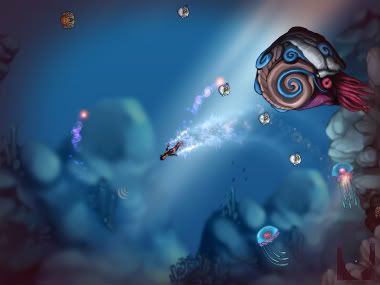
It had been around ten hours that I had spent in the beautiful world of Aquaria, and I felt that my interest was dwindling a bit. Not that I thought the game was bad in any way ; it still looked and sounded like a triumph of art direction, and it still handled like a charm. But I felt that its basic concepts were starting to wear thin, and that the essential flow of the action was becoming routine. It didn't help that I had engaged in paths that I was perhaps not expected to explore at this point (although I certainly appreciated being able to), and it probably made my progression more cumbersome than it should have. But most of all, it started to get very lonely...

Fortunately, these assumptions were momentarily dispelled when I discovered a certain region in the upper parts that presented me with three surprises. The first was the surface of the water, which did not only make for a welcome change of scenery but felt absolutely great to experiment with and also had a certain narrative weight. The second was a large vertical chasm filled with "bubbles" of sorts that had me flying around gleefully for an inordinate amount of time, even though I was never able to reach the secret item conveniently placed just a little too high. And last but not least was a being named Li, of which I will say no more apart from the fact that its partly-interactive, partly-cinematic introduction was handled absolutely brilliantly and significantly reduced the "loneliness" factor without being too intrusive either. All these elements spoke of co-creator Alec Holowka's oft-professed will to craft game experiences of certain emotional depth, while still exulting the kind of simple joy that all games inspired by Zelda or Mega Man aim to evoke.

I have spent some more time with Aquaria since then, going back to explore untouched areas (and one truly feels like it could stretch forever...), but I have now hit a wall and am at a loss about how to progress further. I don't mind this, because it has happened before and I always ended up finding the elegant solutions that the designers came up with. But most of all, whereas before I was questioning my willingness to continue, the hope that there might be other small epiphanies just around the corner, added to the knowledge that my heroine is not so alone after all, makes me feel better and more confident in the authors' proposition. Although I could do without much of the click-heavy action and the occasionally extreme level of difficulty, I now have more reason than ever to heartily recommend this gorgeous and sprawling game to anyone with a taste for adventure.